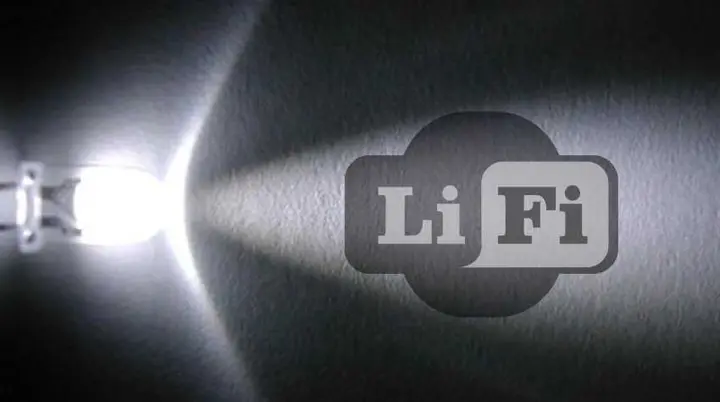
We can't imagine life without the internet, and even an 8-year-old knows what Wi-Fi is. But could the light above your head give you internet too?
The quick answer: Li-Fi is wireless internet that sends data with light instead of radio waves. It's real, but it still isn't in your phone.
When I first wrote this in 2017, Li-Fi was the exciting new thing that sounded like it would replace Wi-Fi.
Nine years later, it has an official standard and real products.
Below, I'll explain what Li-Fi is, how it works, and what actually happened to it.
Also Read: Does Aluminium Foil Boost WiFi Strength? How to Make a Reflector
TL;DR
- What it is: Li-Fi is wireless internet that sends data with light, mostly infrared light you can't see.
- Where it works: Inside one room, or along a straight line between two points, with a clear line of sight and a Li-Fi access point in that room.
- Official standard: IEEE 802.11bb, published in November 2023, with a top speed of 9.6 Gb/s.
- Products: Real Li-Fi systems are sold to offices, schools and secure sites, not to home users. Li-Fi still isn't in everyday phones.
- Heads up: pureLiFi, the company that did the most to push Li-Fi, says on its website that it has ceased trading and gone into administration.
What Is Li-Fi?
Li-Fi is short for Light Fidelity, and it's wireless internet that uses light instead of radio waves. Wi-Fi sends data through the air with radio signals, while Li-Fi sends it with light.
The term was coined by Professor Harald Haas. He showed the idea to the world in his 2011 TED talk, "Wireless data from every light bulb".
When I first wrote this, he was the chief scientific officer of pureLiFi, the company that did the most to push Li-Fi.

How Does Li-Fi Work?
Remember sending messages with a torch, flashing it on and off? Li-Fi works the same way, just far, far faster.
- A Li-Fi light changes its brightness extremely quickly, far too fast for your eyes to notice.
- A small sensor on your device reads those changes as 1s and 0s. That's data.
- Your device sends data back with its own small light.
Light goes in both directions, and that's how you're online.
Does Li-Fi Need Visible Light?
Not usually. Most Li-Fi today uses infrared light, which you can't see at all.
The official Li-Fi standard works with light between 800 and 1000 nanometres, which is infrared.
Signify, the company behind Philips lighting, says its Trulifi systems send data over infrared light that isn't visible to the human eye.
So your room doesn't need to be lit up for Li-Fi to work. This is the part that has changed the most since 2017.

Li-Fi vs Wi-Fi at a Glance
| Li-Fi | Wi-Fi | |
|---|---|---|
| Sends data with | Light (mostly infrared) | Radio waves |
| Goes through walls | No | Yes |
| Covers | One room, or a straight line between two points | A whole home or office |
| Speed in its standard | 10 Mb/s to 9.6 Gb/s (IEEE 802.11bb) | Depends on the Wi-Fi version |
| Built into phones and laptops | Almost never | Almost always |
| Best for | Secure rooms and places where radio isn't allowed | Everything else |
Light not going through walls is both Li-Fi's best and worst feature.
The good side: someone outside your room can't pick up the signal. Signify says it plainly: "light does not travel through walls."
The bad side: you need a Li-Fi access point in every room you want to use it in.
Also Read: How Does Netflix Work? Streaming and Open Connect Explained
What Has Changed Since I First Wrote This
Li-Fi Got an Official Standard
In June 2023, the IEEE approved IEEE 802.11bb, the official standard for Li-Fi. It was published in November 2023.
The best part is that 802.11bb is part of the same 802.11 family as Wi-Fi. pureLiFi said that, with its Light Antenna ONE module, "LiFi simply appears to the system as if it were another band of WiFi".
Real Products Exist, but Not for Your Home
- Signify Trulifi sells Li-Fi systems for offices and schools that don't want Wi-Fi, for secure government spaces, and point-to-point links that reach up to 300 metres. It says one of them is the first Li-Fi system validated to meet the FIPS 140-3 security standard. Its office systems are built for many users at once.
- pureLiFi made the Light Antenna ONE (2023), a Li-Fi module smaller than a US dime meant for phones and laptops, the Kitefin systems for defence, and a "through-window" bridge that brings 5G home internet from outside to inside without drilling holes.
pureLiFi Closed
This one surprised me.
pureLiFi, the company I mentioned all through my 2017 post, says on its website that it ceased trading on 31 August 2026 and has gone into administration.
Why Isn't Li-Fi in Your Phone Yet?
You might be wondering: if Li-Fi is so fast, why doesn't my phone have it? Here's why:
- It needs a clear line of sight. Put your phone in your pocket, and the light can't reach it.
- It needs hardware in every room. Wi-Fi covers your whole house from one router. Li-Fi doesn't.
- Wi-Fi is already everywhere. It's cheap, fast and in every device. Phone makers need a strong reason to add another chip.
pureLiFi built Light Antenna ONE so Li-Fi could go into phones, and said leading phone makers took part in shaping the standard. Even so, Li-Fi still hasn't made it into everyday phones, and the company has now closed.
My honest take: Li-Fi will stay in special places, like secure offices, factories and the military, for a while yet.
Also Read: 5 Biggest Smartphone Myths That Just Won't Die
Common Li-Fi Myths
Is Li-Fi 100 Times Faster Than Wi-Fi?
In 2017, I wrote that Li-Fi was tested at 100 Gbps. Lab records are one thing, though.
The official 802.11bb standard tops out at 9.6 Gb/s.
And just like I said back then, a faster connection inside your room won't speed up a slow internet plan. Your speed still depends on your internet provider and the website you're using.
Will I Lose My Connection in Another Room?
Only if that room doesn't have its own Li-Fi access point.
In 2017, I wrote that you could roam freely because there would be LEDs all over your home. That's how it would work in theory, but it means installing Li-Fi in every room.
Final Thoughts
Li-Fi is real, it works, and it now has an official standard.
But it didn't replace Wi-Fi the way people expected in 2017, and you won't find it in your phone today.
For now, think of it as a clever tool for special places, not something you'll set up at home. If you're looking at a business system, check that the vendor is still trading first, since pureLiFi has closed.
FAQs
Can Many Devices Connect to Li-Fi?
Yes. Signify's office systems are built for many users at once.
Is Li-Fi Safer Than Wi-Fi?
It's harder to snoop on, because light stays in the room. And because it uses no radio waves, it can be used in places where radio signals aren't allowed or don't work well.
Does Li-Fi Work With the Lights Off?
In 2017, I said no. That was true for the visible-light systems people imagined back then, but today's infrared systems work without any visible light.
How Much Does Li-Fi Cost?
In 2017, I said it would be very cheap. Today, Li-Fi is sold to businesses, and there's no simple price for home users.
Still stuck? Tell me through the contact page.

Topics
Comments (6)
Comments are closed. Have a question about this article? Ask through the contact page.


Hii I am Manu And I am Your Daily Visitor Your Posts Are Always Awesome And Helps Me To Increase My Knowledge On Tech.
However I am Having One Problem I Hope That You Will Be Able To Help Me Out. Here Is My Problem-
I have Micromax Spark 2 Plus Running On Marshmallow 6.0. I tried To root it by using various softwares and tried with pc too but i was'nt successful. There is no any recovery made for my phone. So pls help me what to do to root my phone?
Will be always grateful to you if you helped me. :)
Thanks In Advance
Hey Manu Kumar,
Thanks for your kind words. You need to learn porting if you need recovery for your phone.
http://bit.ly/2nuIVj5
Thanks for reply. I have been seeing the method for 1 year. Bro I am new in this field and i don't know to port :(
Xaif Bro I Need recovery.img file for Micromax Canvas Spark 2 Plus. Can You Please Provide Me? :(
We need to code it but unfortunately recovery.img is not available for your phone
It means i can't root my phone?