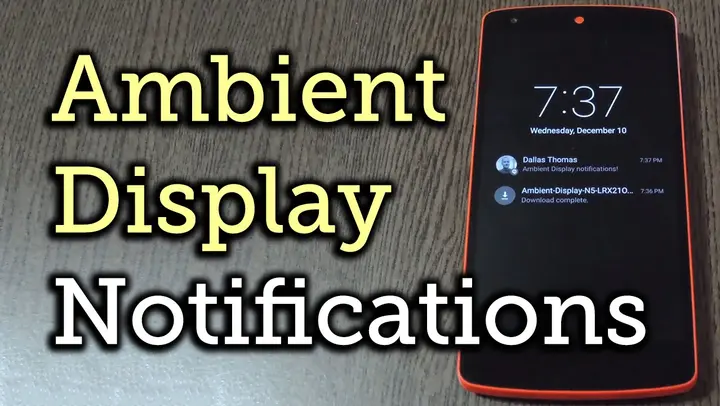
Some of you might have seen the Ambient Display feature in the display settings of your Android device, and some of you might not.
Today, I am going to tell you the two best ways to enable the Ambient Display feature on any Android device.
Some devices don't have this feature, and some do. The reason is simple. Your phone is either not updated to the latest version of Android, or it is old enough.
Also Read: How to Get iPhone 3D Touch Feature in Any Android Device
With these two methods, you can easily get this feature on both rooted and non-rooted Android devices.
On a rooted Android device, you need to install Xposed Installer. On a non-rooted Android device, you need to install an app called AC Display.
What Is Ambient Screen?
The ambient screen is a feature that helps you view notifications without unlocking your Android device. Let's take an example.
Suppose I have a device with Ambient Display turned on. My friend sends me a message, and I am busy for a moment.
I take my phone out of my pocket and check the notification without unlocking the phone.
This feature was first introduced in Lollipop devices, and it is one of the best features Google has given us. If it isn't available on your device, let's look at the guide below.
Also Read: Make Quick Reply to Any Text Message and On WhatsApp

Enable the Ambient Display Feature on Any Android Device
AC Display is the app that helps you enable the Ambient Display feature on your Android device. You will install it from the Play Store.
This app is free. You don't need to pay a penny to the developer to get this feature on your device.
There are some limitations, because the Ambient Display feature in this app is not that good. The reason is that your phone is non-rooted.
If your phone is rooted, you can enjoy the same Ambient Display feature that other Android devices have.
If your Android device is already rooted, you only need to install Xposed Installer and then install the module.
This way, the Ambient Display feature will be available in your Display settings, and you can quickly turn it on and off.
Also Read: Overclock Your Android Device to Boost Performance
How to Enable the Ambient Display Feature on Any Android Device (Non-Rooted Device)
- First, download the AC Display app from Play Store.
- Open the app. You will see a yellow warning option. Just click on it.
- There you will see two options that you need to enable. Click on Device Admin and activate the permission for the app.

- Click back and then click on Notification access.

- Allow notification access on your device.

- Now you can turn this option on, and you are done.

How to Enable the Ambient Display Feature on Any Android Device (Rooted Device)
- Download and install Xposed Installer on your Android device from here: Install Xposed Framework

- Now download the Ambient Display module from here: Download
- Install the module on your device and click on Modules.

- Activate the module and restart your device.
- Go to Settings -- Display -- Ambient Display option. You can now turn this option on.

Image Credits:
Also Read: How to Add a Floating Video Feature to Any Android
Video Tutorial
Wrapping Up
That's it! This is how you can easily enable the Ambient Display feature on your Android device.
I hope you love this article. If you get stuck, tell me through the contact page.
Share this article with your friends.

Topics
Comments (1)
Comments are closed. Have a question about this article? Ask through the contact page.



Awsm guide men, will you please write an article about What the things we need to know/check before buying a laptop. Need explained post about Which is the best company etc all the informative things, it will help us better. If you dont mind please try to make it..... !!