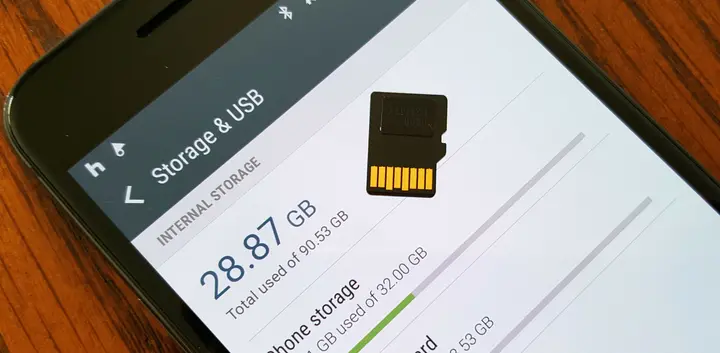
Is one big game eating up all your phone storage?
Back in 2016, I showed you how to install apps and move their OBB files to your memory card. That trick doesn't work on today's phones.
The quick answer: the old root and Xposed method is gone, but if your phone has a microSD slot, Android still lets you put apps on the card the official way.
The old method needed a rooted phone, the Xposed Installer and a module called OBB on SD. Since Android 11, apps can't even reach the folder where OBB files live.
Here, I'll explain what OBB files are, why the old trick stopped working, and which methods still work.
Also Read: How to Fix the “Insufficient Space” Download Error on Android
TL;DR
- The old trick is gone: moving OBB files by hand needs root and Xposed, and Android 11 locked the Android/obb folder.
- Best option: if your phone has a microSD slot, use the card as internal storage (adoptable storage) to install apps on it.
- One game at a time: after the card is set up, open the app's "Storage" page and tap "Change". Only apps whose developers allow it can move.
- No SD slot? Turn on "Automatically archive apps" in the Play Store to free up space.
- Don't copy OBB folders by hand. Deleting or renaming an OBB file makes the game download it again.
What Are OBB Files?
An OBB file holds the extra data for a big game, such as graphics and sounds. It sits next to the app as a separate file.
Back in 2016, a lot of big games came in two parts. The app itself was often only 20 to 50 MB, and the rest, sometimes 1 GB or more, was the OBB file.
Why? Google Play limited the app file to 100 MB.
So big games split their extra graphics and sounds into up to two "expansion files". Google Play saved them in the Android/obb folder on your phone's storage.
That's the file everyone wanted to move to the memory card.
Things have changed since then. From August 2021, new apps on Google Play have to be published as Android App Bundles.
Google now points big new apps to Play Asset Delivery instead of OBB files. A newer game may not have an OBB file at all.
Why the Old OBB Trick Doesn't Work Anymore
The old method stopped working for three reasons.
- It needed root and Xposed. Rooting is a big step just to save some space, and that 2016 module was made for the Android versions of that time.
- Android 11 locked the folder. Apps can no longer open other apps' folders under Android/data and Android/obb. Even file managers with "All files access" can't get in there.
- Moving the file makes the game download it again. Google tells developers that if an OBB file is deleted or renamed, Google Play (or the game itself) will download it again.
So please don't copy OBB folders by hand anymore.
Which Methods Still Work on Android?
Android still lets you move apps to a memory card, but only through its own tools. Here's how the options compare.
| Method | Phone needed | Root needed | Best for |
|---|---|---|---|
| Adoptable storage | Phone with a microSD slot | No | Installing apps and games on the card |
| "Change" button | Phone with a microSD slot and a card set up for apps | No | Moving one app at a time |
| Automatically archive apps | Phones without a card slot | No | Freeing up space on the phone itself |
Requirements
- A phone with a microSD card slot. Pixel phones don't have one, so check your phone's specs first.
- A fast microSD card. Android can warn you when a card is too slow to use for apps.
- A backup of the card. Setting it up for apps erases everything on it.
How to Use an SD Card as Internal Storage
Adoptable storage has been part of Android since Android 6.0. The card becomes part of your phone's own storage, so you can install apps on it, not just keep photos and videos.
For a New Card
- Put the card in your phone.
- Swipe down from the top of the screen and tap the "SD card detected" notification.
- Tap "Format another way". ("Format" sets it up as a normal, portable card instead.)
- When it's done, choose "Move content", or "Move content later" if you want to do it later.
For a Card Already in Your Phone
- Open "Settings" → "Storage" → "SD card".
- Open the menu and tap "Storage settings" → "Format" → "Format another way" → "Format".
If you don't see an option to use the card as internal storage, your phone doesn't support it.
What About the OBB Folder?
You might be wondering: what about the OBB folder?
When Android offers to move your content, it moves your phone's shared storage to the card. That's the same storage where the Android/obb folder lives.
That's much safer than moving the folder by hand.
Things to Know First
Before you start, keep three things in mind:
- The card only works in this phone. Android encrypts it for this one device, so you can't read it in another phone or a PC.
- Don't take the card out. Apps and files on it won't work until you put it back.
- A slow card means slow apps. Buy a good card if you're going to install games on it.
How to Move a Single App to the SD Card
Once your card is set up for apps, you can move apps one at a time with the "Change" button.
- Open "Settings" → "Apps".
- Tap the game you want to move.
- Tap "Storage".
- Tap "Change", choose your SD card, and tap "Move".
The names of these menus are a little different on every phone.
What If There's No Change Button?
Then that app can't be moved. An app can only go on the SD card if its developer allows it, and many don't.
You can move an app back the same way. Just choose your internal storage instead.
Also Read: How to Increase RAM on Android: Virtual RAM, RAM Plus and the Old SD Card Trick
What If Your Phone Doesn't Have an SD Card Slot?
Then you'll have to free up space on the phone itself. The Play Store has a setting that helps a lot here.
- Open the Play Store, tap your profile picture, then "Settings" → "General".
- Turn on "Automatically archive apps".
It removes apps you rarely use but keeps your data and the app icon. When you need the app again, it reinstalls from Google Play.
You can also clear junk and big files with Files by Google, which I wrote about in my guide to fixing storage errors.
Also Read: How to Repair a Corrupted Memory Card or USB Pendrive
Which Method Should You Use?
It depends on your phone and how many games you want to move:
- Phone with a microSD slot, many apps: use the card as internal storage.
- Only a few big games: move them one at a time with "Change", if the developer allows it.
- No card slot: turn on automatic archiving and clear space with Files by Google.
Final Thoughts
The old root and Xposed trick is gone, and Android 11 locked the OBB folder for good.
If your phone has a card slot, using the card as internal storage still gives your games more room. Use the "Change" button for one-off moves, and leave the OBB folder alone.
If your phone has no card slot, turn on automatic archiving and clear out junk files to get space back.
FAQs
Can I still move OBB files to an SD card on Android?
No, not by hand, because since Android 11 apps can't reach the Android/obb folder. Use the card as internal storage (adoptable storage) instead, and never delete or rename an OBB file.
Do I need root to move apps to an SD card?
No. The old method needed root and Xposed, but the built-in options (adoptable storage and the "Change" button) don't.
Why is there no "Change" button for my game?
Only apps whose developers allow it can move to the SD card, and many don't. If there's no "Change" button, that app can't be moved.
What if my phone has no SD card slot?
Turn on "Automatically archive apps" in the Play Store under Settings → General. It removes apps you rarely use but keeps your data and icon, and reinstalls them from Google Play when you need them.
Still stuck? Tell me through the contact page.

Topics
Comments (4)
Comments are closed. Have a question about this article? Ask through the contact page.

How to install exposed on lollipop 5.1.1without recovery?
Using custom recovery is mandatory to install xposed installer
Is this module works in Android 6.0.1
Yes, it works