 TechVerge
Do you do the same things on your phone every single day?
Turn on Wi-Fi, open WhatsApp, silence your phone at night. Then turn the sound back on in the morning.
Doing all of that one by one wastes your time. What if your phone did it for you?
The quick answer: start with what's built in.
On a Pixel or many other Android phones, use Modes. On a Samsung Galaxy, use Modes and Routines.
When you want more control, use Tasker. In 2017, I showed you how to get started with it, and it's still the most powerful option.
In this guide, I'll show you how to get started with Android automation, from the easy built-in way to Tasker.
Also Read: 9 Cool Android Hacks You Can Try (No Root Needed)
TL;DR
- Built in first: on a Pixel or many other Android phones, use Modes. On a Samsung Galaxy, use Modes and Routines.
- Tasker for everything else: it can react to more than 130 states and events and run more than 350 actions.
- No root needed: Tasker's own page says it works without root. Only a few actions need it.
- Watch out for: Wi-Fi and Bluetooth actions need Tasker's helper app, Tasker Settings, and battery optimisation can stop Tasker in the background.
What Is Android Automation?
Android automation makes your phone carry out a set of actions for you when something happens.
The trigger can be a time of day, a location, an app you open or an incoming call.
Does Android Automation Need Root?
No, it doesn't.
In my 2017 post, I said you had to root your phone to use Tasker. That wasn't right.
Tasker's own page says it works without root. Only a few actions need it, like killing apps and, on some phones, turning mobile data on or off.
The built-in tools below don't need root either.
Android Automation Tools at a Glance
| Tool | Works on | Root needed | Best for |
|---|---|---|---|
| Modes | Pixel and many other Android phones | No | Silencing your phone, cutting distractions or getting ready for bed on a schedule |
| Modes and Routines | Samsung Galaxy phones | No | "If this, then that" automations, with nothing to install |
| Tasker | Android (paid app) | No, but a few actions need it | Automating almost anything, with full control |
Which Android Automation Tool Should You Use?
Start with what your phone already has. It's enough for many everyday routines.
- Pixel or many other Android phones: start with Modes.
- Samsung Galaxy: use Modes and Routines for "if this, then that" automations.
- Anything more: use Tasker. It takes some learning, but it can do almost anything.
Option 1: Modes on Pixel and Other Android Phones
On Pixel phones and many other Android phones, Do Not Disturb has grown into Modes.
A mode is a set of rules for your phone. It decides who can call you, which apps can send you notifications, and how your screen looks while it's on.
Ready-made modes like Bedtime and Driving come built in, and you can make your own.
- Open "Settings" → "Modes".
- Tap "Create your own mode".
- Give it a name and choose an icon.
- Tap "Done".
- Now choose who and which apps can interrupt you, and change the display settings if you want.
The ready-made modes can switch on by themselves. Bedtime can follow a schedule, and Driving can turn on "While driving".
If you don't see "Modes", search your Settings for "Do Not Disturb". Your phone may still have the older version.
Option 2: Modes and Routines on Samsung Galaxy Phones
Samsung's Modes and Routines lets you build real "if this, then that" automations, without installing anything.
On Android 13 and newer, it's in "Settings" → "Modes and Routines". On Android 11 and 12, it was a separate app called Bixby Routines.
Use a Ready-Made Routine
- Open "Settings" → "Modes and Routines".
- Tap "Discover".
- Pick a suggestion, like "Going to work".
- Check what it does, and tap "Save".
Make Your Own Routine
- Open Modes and Routines and tap "Routines".
- Tap the "+" icon.
- Add the condition that starts it, like a time of day.
- Add the actions you want it to do.
- Tap "Save", give it a name and an icon, and tap "Done".
Your routine now runs by itself.
Want to open it faster? Go to "Modes and Routines", tap the More icon → "Settings", and turn on "Show Modes and Routines on Apps screen".
Option 3: Tasker for Automating Everything
If the built-in tools can't do what you want, Tasker probably can.
Its Google Play listing says it has more than 130 states and events to react to, and more than 350 actions. They cover location, Wi-Fi network, the app you're in, the time, incoming calls and SMS, the song that's playing, and a lot more.
How Tasker Works
Tasker has three main ideas:
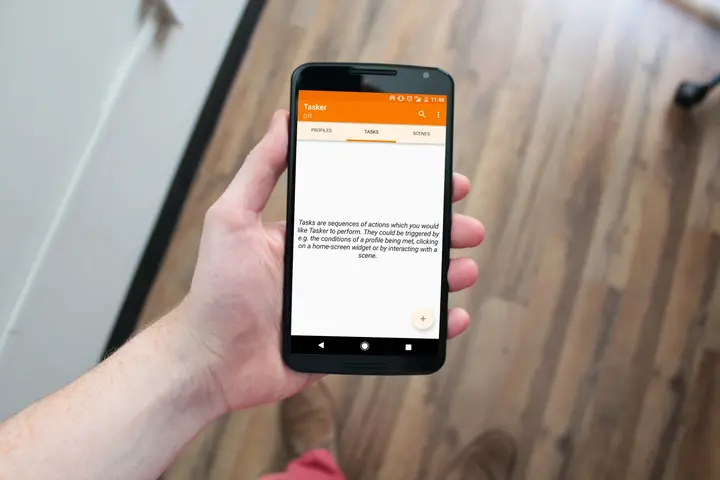
- Tasks are lists of actions, like "open WhatsApp" or "set the volume to zero".
- Profiles connect a trigger (Tasker calls it a context) to a task. For example, "at 7 AM, run my morning task".
- Scenes let you design your own little screens and buttons.
Requirements
- Tasker from Google Play. In 2017, it cost around $2.99. In November 2026, it's $4.49 on Google Play in the US, and prices vary by country. It's a one-time payment, and it's also included with Google Play Pass.
- Want to try first? Tasker's official site has a 7-day trial.
Step 1: Create a Task
- Open Tasker and tap the "Tasks" tab.
- Tap the "+" button and give your task a name.

- Tap the tick, and you'll land on the Task Edit screen.

Step 2: Add Actions
- Tap "+" to add an action.
- Pick a category, like App, Audio, Display or Net, and then the action you want.

- Add as many actions as you need. They run from top to bottom.
My advice from 2017 still stands: open every category and look around. That's the best way to learn what Tasker can do.
Step 3: Test It
Tap the play button at the bottom of the Task Edit screen.

All your actions run one after another, with a single tap.
Step 4: Make It Run Automatically
A task you have to start yourself is useful. A task that starts by itself is better.
- Go back and open the "Profiles" tab.
- Tap "+" and pick what should trigger it, like Time, Application or Location.
- Set it up, then go back. Tasker asks which task to run. Pick the one you just made.
Now, every time that condition is true, your task runs on its own.
Also Read: How to Schedule WhatsApp Messages on Android and iPhone
What to Watch Out For With Tasker
Why Can't Tasker Turn On Wi-Fi Anymore?
Android doesn't let apps built for its newer versions turn Wi-Fi or Bluetooth on and off by themselves.
So Tasker hands those actions to its official helper app, Tasker Settings, which is built in a way that's still allowed to do them. If an action asks for it, install it from that official page.
Does Tasker Stop Working in the Background?
Android tries to save battery by stopping apps in the background.
Tasker's own FAQ says to turn off battery optimisation for Tasker and its plugins. On Samsung and some other brands, you may also need to let it run in the background in the app's battery settings.
Also Read: How to Increase Battery Life on Android (2 Methods, No Root)
Final Thoughts
Start with what's already on your phone: Modes on a Pixel, or Modes and Routines on a Samsung Galaxy. For many people, that's all they need.
When you outgrow them, get Tasker. It takes some learning, but it can save you a lot of time.
Just remember the main caveat: Wi-Fi and Bluetooth actions need Tasker Settings, and battery settings may need changing.
Menu names move around with each Android update, so if a step doesn't match your screen, look for the closest match and keep going.
FAQs
Does Android automation need root?
The built-in tools and Tasker both work without root, and only a few Tasker actions need it, like killing apps and, on some phones, turning mobile data on or off.
Which Android automation app is the most powerful?
Tasker is still the most powerful option covered here. It can react to more than 130 states and events and run more than 350 actions.
Why can't Tasker turn Wi-Fi on or off?
Android doesn't let apps built for its newer versions do that by themselves. Install the official helper app, Tasker Settings, and Tasker uses it for those actions.
Can Tasker run automatically without me opening it?
Yes, once you set up a profile in the Profiles tab with a trigger such as Time, Application or Location. Turn off battery optimisation for Tasker so Android doesn't stop it.
Do I need Tasker if my phone already has Modes?
Not always. Modes and Routines handle many everyday schedules, so start there and move to Tasker when you need more control.
Still stuck? Tell me through the contact page.