
Does a website refuse to open on your PC, even though your internet is working fine?
Sometimes the site isn't down. Your internet provider has blocked it.
The short answer: changing your DNS to Google's servers (8.8.8.8 and 8.8.4.4) only gets around one kind of block, the kind that happens in DNS.
When I first wrote this in 2016, the title promised that Google DNS would unblock all blocked websites. It never could.
In this guide, I'll show you which blocks it can fix, which it can't, and how to set Google DNS on Windows 11.
Also Read: A Simple DNS Tweak to Speed Up Your Internet (Android & Windows)
TL;DR
- What it fixes: sites your provider blocks through its own DNS, and sites that won't load because your provider's DNS is down or slow.
- What it can't fix: blocks that don't use DNS, school and office firewalls, and sites that block your country.
- How to set it on Windows 11: enter 8.8.8.8 and 8.8.4.4 as your DNS servers in Settings, then clear the DNS cache.
- If the site still won't open: the block works some other way. For that, you'd need a trustworthy VPN or Tor Browser.
Before You Start: A Quick Note
- School and work networks have their own rules. If your school or office blocks a site on purpose, getting around it can get you in trouble. Ask the IT team first.
- Some sites are blocked by law. Check your local laws.
- This isn't for piracy. I've dropped the old examples from this post for that reason.
This guide is for normal sites that your provider blocked by mistake, or sites that won't open because your provider's DNS is acting up.
What Is DNS?
DNS stands for Domain Name System, and you can think of it as the internet's phonebook.
You type a name like google.com, and DNS looks up the IP address behind it, so your PC knows where to connect.
By default, your PC uses your internet provider's DNS server. You can swap it for another one, such as Google Public DNS.
Blocks Google DNS Can and Can't Fix at a Glance
Google DNS helps with some blocks and not others. Check your case in this table.
| Problem | Can Google DNS fix it? | Why |
|---|---|---|
| Your provider blocks a site through its DNS server | Yes | Google's DNS doesn't use your provider's blocklist. |
| Your provider's DNS server is down or slow | Yes | Google's DNS answers the lookup instead. |
| Your provider replaces "site not found" answers with its own pages | Yes | Google Public DNS doesn't do this. |
| Your provider blocks the site's IP address or inspects your traffic | No | The block doesn't depend on DNS. |
| School or office firewall | No | These networks often filter everything or force their own DNS. |
| The website blocks your country | No | That's the website's choice, whatever DNS you use. |
| A domain Google blocks | No | Google's DNS doesn't block or filter, except certain domains in rare cases. |
What Can Google DNS Unblock?
What It Can Fix
- Sites your provider blocks through its own DNS. Some providers block a site by making their DNS server give a wrong answer, or no answer at all. Google's DNS doesn't use that blocklist, so the site opens again.
- Sites that won't load because your provider's DNS is broken. If its DNS server is down or slow, nothing opens, even though your internet is on.
- Fake "not found" pages. Google says in its Public DNS FAQ that some providers replace "this site doesn't exist" answers with pages on their own servers. Google Public DNS doesn't do that.
What It Can't Fix
- Blocks that don't use DNS. If your provider blocks the site's IP address or checks your traffic directly, a new DNS server makes no difference.
- School and office firewalls. These networks often filter everything, or force your PC to use their own DNS anyway.
- Sites that block your country themselves. That's the website's choice, and it happens no matter which DNS you use.
- Domains Google blocks. Google says its DNS doesn't block or filter anything, except certain domains in rare cases, like security threats or when it's legally required to.
For those, you'd need a trustworthy VPN or Tor Browser. I've explained both in my Android guide.
Also Read: How to Unblock Blocked Websites on Android (3 Safe Ways)
How to Use Google DNS on Windows 11
You can set Google DNS in Settings, or use the older Control Panel method.
Requirements
- A Windows 11 PC. The Control Panel method works on Windows 10 too.
- An administrator account.
- Google's DNS addresses: 8.8.8.8 and 8.8.4.4.
Method 1: Settings
- Open "Settings" → "Network & internet".
- Click "Wi-Fi", then "Hardware properties". For a wired connection, click "Ethernet" instead.
- Next to "DNS server assignment", click "Edit".
- Change it from "Automatic (DHCP)" to "Manual" and turn on "IPv4".
- Type 8.8.8.8 as the preferred DNS and 8.8.4.4 as the alternate DNS.
- Set "DNS over HTTPS" to "On (automatic template)" in the same window. This encrypts your lookups, so your provider can't easily change the answers.
- Click "Save".
Your PC now uses Google DNS. Next, clear the old answers, as described below.
Method 2: Control Panel
This is the method from my 2016 post, and it still works in Windows 11.
In 2016, I opened it through "Network & Sharing Center" → "Change adapter settings". Here's a quicker way to get there.
- Press Windows + R, type
ncpa.cpland press Enter. - Right-click the connection you're using (Wi-Fi or Ethernet) and choose "Properties".
- Select "Internet Protocol Version 4 (TCP/IPv4)" and click "Properties".
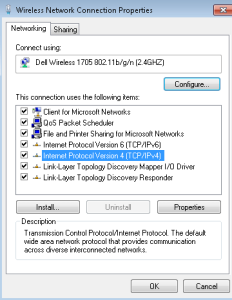
- Choose "Use the following DNS server addresses".
- Type 8.8.8.8 as the preferred DNS server and 8.8.4.4 as the alternate DNS server.
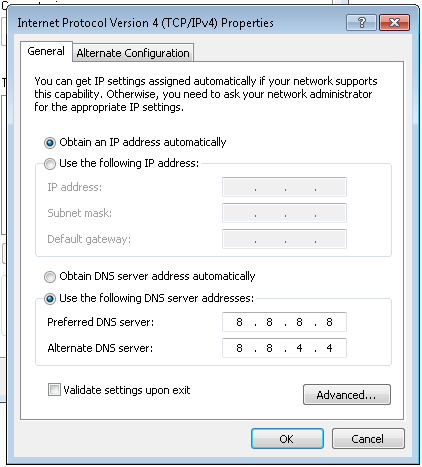
- Click "OK", then close the Properties window.
For IPv6
If your connection uses IPv6, do the same steps with "Internet Protocol Version 6 (TCP/IPv6)", and use 2001:4860:4860::8888 and 2001:4860:4860::8844.
Clear the DNS Cache and Try Again
Windows remembers old DNS answers for a while, so clear them after you switch.
- Search for "Command Prompt" in the Start menu, right-click it and choose "Run as administrator".
- Type
ipconfig /flushdnsand press Enter. - Close your browser, open it again and reload the site.
If the site opens now, the block was at the DNS level, and you're done.
If it still doesn't open, it's blocked some other way, and a DNS change won't help.
Also Read: How to Block Pop-Up Ads on Android (No Root Needed)
How to Undo It
Go back to the same window and switch to "Automatic (DHCP)" in Settings, or "Obtain DNS server address automatically" in Control Panel.
Do this if you take your laptop to a school, office or hotel network and things stop loading.
Final Thoughts
Google DNS won't unblock every website. It never did, even in 2016.
When your provider blocks a normal site through its DNS, or its DNS just stops working, switching to 8.8.8.8 fixes it in two minutes. For anything else, a DNS change won't help, and you'd need a trustworthy VPN or Tor Browser.
Providers change how they block sites, so a DNS fix that works today may not work for every block later on.
FAQs
Will changing to Google DNS unblock every blocked website?
Google DNS only gets around blocks that happen through DNS, like a provider's DNS blocklist or a broken DNS server. Blocks by IP address and school or office firewalls still apply.
What are the Google DNS addresses for Windows 11?
The IPv4 addresses are 8.8.8.8 and 8.8.4.4. For IPv6, use 2001:4860:4860::8888 and 2001:4860:4860::8844.
Why does a site still not open after I change DNS?
Windows may still be holding old DNS answers, so run ipconfig /flushdns in an administrator Command Prompt and reload the site. If it still won't open, the block isn't DNS-based.
How do I switch back to my provider's DNS?
In Settings, choose "Automatic (DHCP)", or in Control Panel, choose "Obtain DNS server address automatically". Do this on school, office or hotel networks if things stop loading.
Still stuck? Tell me through the contact page.

Topics
Comments (2)
Comments are closed. Have a question about this article? Ask through the contact page.



superb trick bro.. very useful
But how to bypass fortinet blocked websites in clz and schools