TechVerge
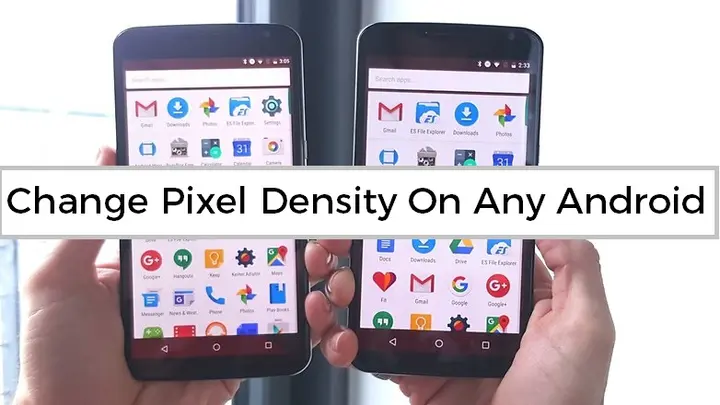
Do the icons and text on your phone look too big?
Or maybe you want more apps and more lines of chat on your screen?
On Windows, you can change the scaling in a second. On Android, that setting is called pixel density, or DPI.
When I first wrote this in 2017, Android 7.0 had just added a Display size slider. For anything more, you needed an app called DPI Changer and a long ADB command.
Today, you don't need either. In this guide, I'll show you three ways to change pixel density on Android, and none of them need root.
Also Read: Minimal ADB and Fastboot: Download the Official ADB Instead

TL;DR
- Easiest: open "Settings", search for "Display size" and move the slider.
- Finer control: set "Smallest width" in Developer options. A higher number makes things smaller.
- Exact DPI number: from a PC, set it with
adb shell wm densityand a number, such asadb shell wm density 400. Undo it withadb shell wm density reset. - No root and no extra app are needed for any of these methods.
What Is Pixel Density (DPI)?
Your screen has a fixed number of pixels, and that never changes. What you can change is how big Android draws things on those pixels.
- Higher DPI makes everything bigger, so less fits on the screen.
- Lower DPI makes everything smaller, so more fits on the screen.
You might be wondering whether this is the same as font size. It isn't.
Font size only changes text, while pixel density changes everything: icons, buttons, menus and text.
Also Read: How to Change the System Font on Android Without Root
Pixel Density Methods at a Glance
| Method | Where to find it | Needs a PC? | Root needed? | Best for |
|---|---|---|---|---|
| Display size | Settings | No | No | Quick, safe changes |
| Smallest width | Developer options | No | No | Fine-tuning in small steps |
| ADB and wm density | Command line on a PC | Yes | No | Setting an exact DPI number |
Method 1: Use Display Size (Easiest)
This is built into Android, and it's the safest way to change it.
- Open "Settings".
- Search for "Display size".
- Move the slider left to make everything smaller, or right to make it bigger.
On a Pixel, you'll find it under "Display size and text", together with "Font size". Some brands use a different name for this setting, so searching in "Settings" is the quickest way to find it.
The slider only has a few steps. For finer control, use Method 2.
Method 2: Use "Smallest Width" in Developer Options
This setting is hidden in Developer options, but it lets you choose any value you like.
- Go to "Settings" → "About phone" and tap "Build number" seven times, until you see "You are now a developer!" On Samsung phones, "Build number" is inside "Software information".
- Go back and open "Developer options". On a Pixel, it's in "Settings" → "System".
- Scroll down and tap "Smallest width".
- Enter a new number and save it.
Here's the trick: the number is in dp, and it works the opposite way to DPI. A higher smallest width makes everything smaller, and a lower one makes everything bigger.
Change it in small steps, like 20 or 30 at a time. Write down the original number first, so you can go back.
Method 3: Use ADB and wm density
This is the method for people who want the exact DPI number.
Requirements
- A PC with ADB. Here's my guide to setting up ADB on Windows.
- "USB debugging" turned on in "Developer options".
Steps
- Connect your phone and open a Command Prompt in your platform-tools folder.
- Check your current density with this command:
adb shell wm density
- Set a new density. For example:
adb shell wm density 400
- Want to go back to normal? Type:
adb shell wm density reset
The change shows up right away, and you don't need any app for it.
Also Read: How to Downgrade an App Without Losing Data on Android
In 2017, you had to install DPI Changer and give it a special permission with ADB first. Now Android's own wm command does the job.
There's also adb shell wm size, which changes the screen resolution. I'd leave that one alone unless you know what you're doing.
Is Changing DPI Safe?
My 2017 post warned that a very high value could brick your phone. That warning was too scary.
Changing density is just a setting. It doesn't flash or replace anything, so it can't brick your phone the way a bad flash can.
Keep in mind: an extreme value can make the screen hard to use, and some apps may look broken. If that happens, set it back:
- In "Display size" or "Smallest width", return to your original value.
- With ADB, run
adb shell wm density reset.
Which Method Should You Use?
- Most people: use the Display size slider. It's all you need.
- Finer control: use "Smallest width" in Developer options.
- An exact DPI number, from your PC: use
adb shell wm density.
Final Thoughts
Changing pixel density on Android no longer needs root or a special app.
Start with the Display size slider. If you want finer steps, use Smallest width, and only reach for ADB when you need an exact number.
If you want your phone to look like a Pixel with lots of space on screen, Smallest width gives you full control, and wm density does the same from your PC.
Menu names differ between brands and Android versions, so the exact labels on your phone may not match this guide. Change the value in small steps, and write down the original so you can go back.
FAQs
Does changing pixel density on Android need root?
No, all three methods in this guide work without root. Display size and Smallest width are built in, and ADB only needs a PC with USB debugging turned on.
What is the difference between pixel density and font size?
Font size only changes text. Pixel density changes everything on the screen, including icons, buttons, menus and text.
Is it safe to change pixel density on Android?
It's only a setting, so it can't brick your phone the way a bad flash can. An extreme value can still make the screen hard to use, so set it back with the Display size slider, your original Smallest width value, or adb shell wm density reset.
How do I reset pixel density to the default?
Move the Display size slider back to its original position, or set Smallest width back to the number you wrote down. If you used ADB, run adb shell wm density reset.
Why does a higher Smallest width make everything smaller?
Smallest width is measured in dp, which works the opposite way to DPI. A higher number makes everything smaller, and a lower number makes everything bigger.
Still stuck? Tell me through the contact page.